I made a meme that captures the current state of AI adoption better than any McKinsey slide deck:
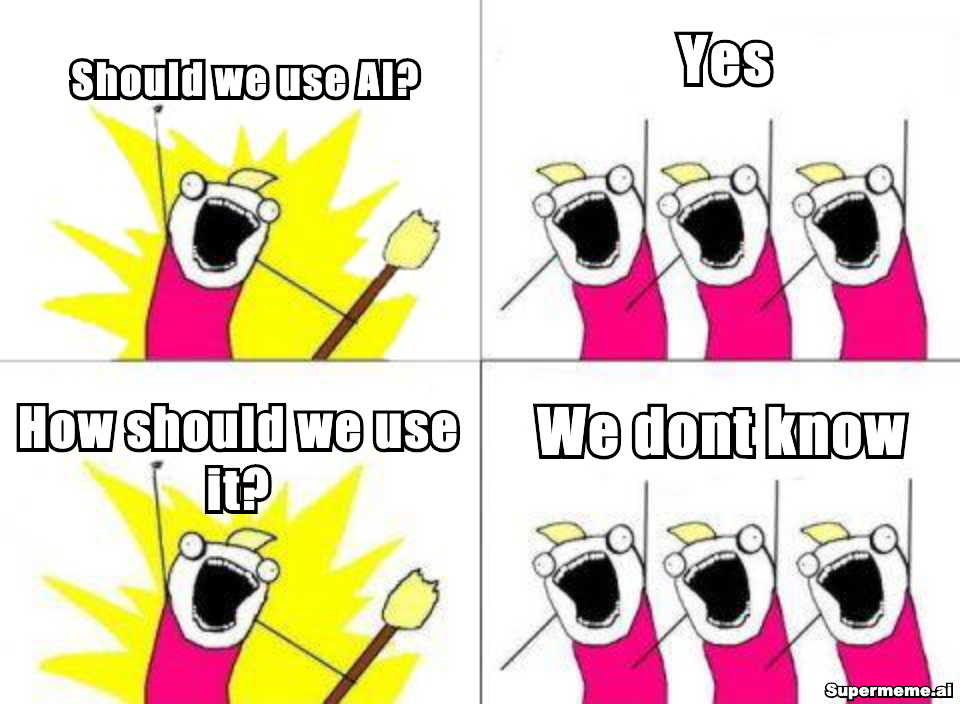
That’s it. That’s the whole industry right now.
Every company wants to “leverage AI.” Every roadmap has an AI initiative. Every CEO has told the board something about transformation. The enthusiasm is unanimous and genuine — nobody is saying no.
But ask the follow-up question — how — and the room goes quiet. Not because people are stupid, but because the honest answer is uncomfortable: we haven’t figured that out yet.
The decision to use AI is easy. The decision of where and how is the actual work.
I’ve seen this play out in multiple organizations over the past year. Someone senior decides the team should use AI. A Slack channel gets created. Maybe a hackathon. People try Copilot for a week, generate some tests, summarize a few documents. There’s a demo. Everyone claps.
Then nothing changes.
The daily work stays the same. The same bottlenecks remain. The same meetings happen. The AI tool becomes another tab that’s open but rarely used, like that Confluence page everyone bookmarked and nobody reads.
The problem isn’t the tooling. The tooling is honestly incredible right now. The problem is that most teams treat AI adoption as a technology decision when it’s actually a workflow decision.
Buying Copilot licenses doesn’t make your team AI-powered any more than buying a gym membership makes you fit. The value comes from changing how you work — what you delegate, what you review, what you stop doing entirely.
AI doesn’t remove work. It shifts where the work happens — from producing to reviewing, from writing to prompting, from building to evaluating.
That shift requires intention. It requires someone sitting down and asking: what does our team actually spend time on, and which of those things can be done differently now?
Here’s what I’ve seen work. Not a framework, not a strategy deck — just patterns that seem to stick:
-
Start with the annoying stuff. Not the exciting use cases. The boring, repetitive tasks that everyone hates. Boilerplate code, test scaffolding, migration scripts, changelog summaries. If AI can take those off someone’s plate, adoption happens naturally because people want to use it.
-
Make it part of the flow, not a separate step. If using AI means switching tools, opening a new app, copying context back and forth — people won’t do it. It needs to live where the work already happens. IDE integration, CI pipeline steps, PR review automation.
-
Let people figure out their own patterns. Top-down mandates like “everyone must use AI for code review” create resistance. Instead, give people access, share what’s working, and let the good patterns spread. The best AI workflows I’ve seen were discovered by individual developers and then adopted by the team because they were obviously better.
-
Accept that some things won’t work. Half of your AI experiments will be underwhelming. That’s fine. The other half will save hours per week. You just have to run enough experiments to find them.
The meme is funny because it’s true. But the underlying problem is serious. Companies that stay in the “yes but we don’t know how” phase for too long will watch their competitors figure it out first.
The answer isn’t to wait for a perfect strategy. It’s to start small, learn fast, and be honest about what’s actually working versus what just looks good in a demo.
The companies that win with AI won’t be the ones that adopted it first. They’ll be the ones that figured out where it actually matters.